

Foxconn Got Hit Four Times. ThreatLocker Would Have Stopped All of Them.
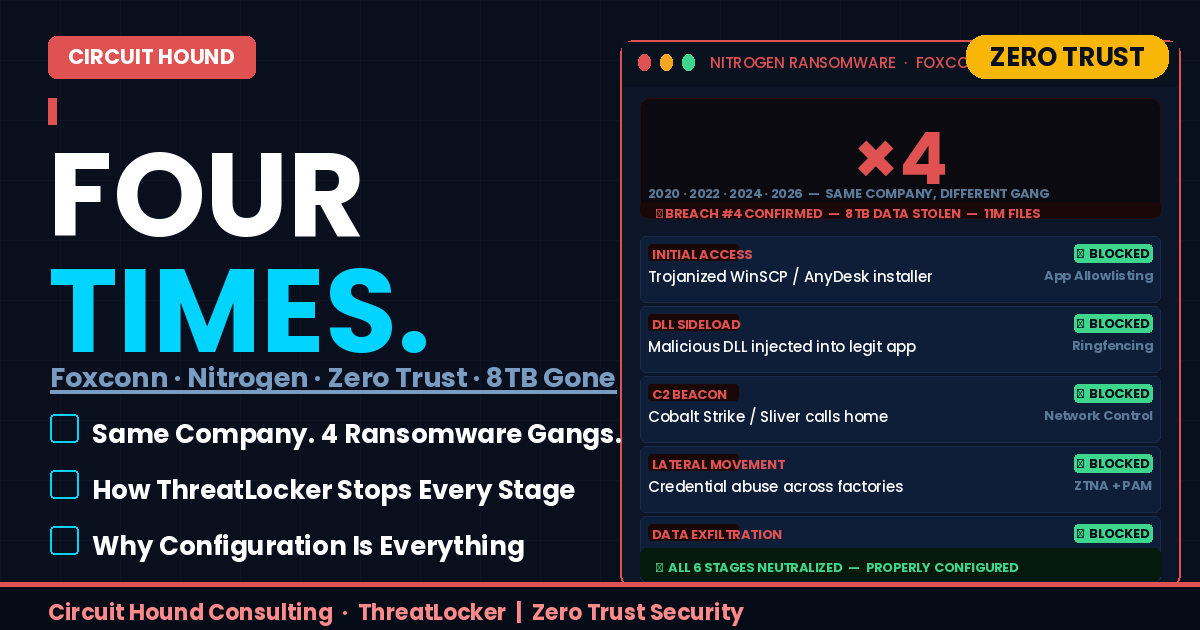
Let me put this as plainly as I can. Foxconn — the world’s largest contract electronics manufacturer, the company that builds products for Apple, Google, Nvidia, AMD, and Intel — has been successfully ransomwared four times since 2020. Four. Different gangs. Same outcome every time.
The most recent hit was May 2026. The Nitrogen ransomware group walked out with 8 terabytes of data and over 11 million files — engineering documents, circuit board layouts, network topologies, and confidential project data tied to some of the most valuable IP on the planet. Factories in Wisconsin and Texas went dark. Workers were sent home. Timecard systems went offline. Some facilities reverted to paper.
|
2020
DoppelPaymer
$34M ransom demand
|
2022
LockBit
Mexico facility
|
2024
LockBit
Foxsemicon, 5TB stolen
|
2026
Nitrogen
8TB, 11M files, 4 factories
|
A properly implemented ThreatLocker environment breaks the Nitrogen attack chain before it even gets started. Not at the end. Not during recovery. Let’s walk through exactly how the attack unfolded, how ThreatLocker breaks the chain at every stage — and why configuration expertise is what actually separates the two outcomes.
How Nitrogen Got In — And Why It Should Have Been Stopped at the Door
Nitrogen didn’t use some exotic zero-day. They ran a malvertising campaign pushing trojanized installers of legitimate IT tools — WinSCP, AnyDesk, PuTTY, Cisco AnyConnect, Slack, FileZilla. Tools that IT staff download all the time, from what appeared to be legitimate vendor sites. The installer drops a malicious DLL which sideloads into the legitimate application, beacons out to Cobalt Strike or Sliver command-and-control infrastructure, and from there the attackers harvest credentials, move laterally across factories, exfiltrate data, and deploy ransomware with an ESXi encryptor so broken that decryption was impossible even if you paid.
Now let’s walk through how ThreatLocker kills every single stage of this.
Stage 1 — Initial Access & Tool Delivery
Misconfigured — Attack Succeeds
Approving WinSCP by publisher name or install path rather than cryptographic hash means a convincingly packaged trojan walks right through. If the allowlist says “trust anything signed by WinSCP” — the trojanized installer passes. The attacker has a foothold before your security team knows anything happened.
Properly Configured — Attack Blocked
Application Allowlisting under a true default-deny policy means nothing executes unless it is explicitly approved by hash. That trojanized binary hits the ground dead. No foothold. No lateral movement to worry about. Attack over — Stage 1.
Stage 2 — DLL Sideloading & Persistence
Even if the installer somehow executed, the DLL sideloading technique runs into the next wall. This is where modern attackers get clever — they don’t bring their own tools. They use yours. A malicious DLL riding inside a legitimate application is invisible to antivirus. It’s supposed to be there.
Misconfigured — Attack Succeeds
If Ringfencing is at defaults or disabled, the malicious DLL sideloads freely. The loader establishes persistence and beacons out. Cobalt Strike has everything it needs.
Properly Configured — Attack Blocked
Application Ringfencing defines exactly what an approved application can do. A properly configured policy means the application cannot load an unauthorized DLL. The payload tries to sideload, ThreatLocker blocks it. No foothold. No loader. No beacon.
Stage 3 — Command & Control Beacon
Misconfigured — Attack Succeeds
Without Network Control, approved applications can communicate with any destination. Cobalt Strike beacons out. The attacker receives instructions and the attack advances. The network sees nothing unusual — just legitimate software making outbound connections.
Properly Configured — Attack Blocked
Network Control defines exactly which destinations each approved application may reach. An unexpected outbound connection to a Bulgarian command-and-control server gets dropped instantly. The attacker is blind. No instructions received. No further stages.
Stage 4 — Lateral Movement Across Factories
Nitrogen’s playbook after establishing a foothold is credential harvesting and east-west lateral movement — hopping from system to system across the factory floor network. Wisconsin to Texas. Production systems to IP repositories. The blast radius expands with every step.
Misconfigured — Attack Succeeds
Without enforced ZTNA and PAM, hijacked credentials give an attacker the run of the network. They move freely from endpoint to endpoint, escalate privileges, and reach systems that were never meant to be touched. You don’t find out until it’s too late.
Properly Configured — Attack Blocked
Zero Trust Network Access means there is no east-west traffic by default. Every device-to-device connection must be explicitly authorized. ThreatLocker PAM eliminates standing admin privileges. A compromised endpoint trying to reach another system gets dropped. The attacker can’t pivot.
Stage 5 — 8TB Data Exfiltration
Nitrogen exfiltrated 8 terabytes over web services before the ransomware even deployed. Engineering documents. Confidential project files for Apple, Google, Nvidia, Intel. All of it gone before anyone knew there was a problem.
Misconfigured — Attack Succeeds
Without Storage Control, any elevated process has full read access to everything — critical directories, IP documentation, network shares. Nitrogen walks out with the whole vault.
Properly Configured — Attack Blocked
Storage Control locks down exactly which applications can read from sensitive directories — and where data can go. That exfiltration path has to be explicitly authorized. Blocked before a single document leaves the building.
Stage 6 — Ransomware Deployment & Data Wipe
Misconfigured — Attack Succeeds
Without write-action limits, the ransomware encrypts freely. And because of a bug in Nitrogen’s own ESXi encryptor, decryption is impossible even if the ransom is paid. There’s no recovering from this without tested, isolated backups.
Properly Configured — Attack Blocked
Storage Control governs write access to protected directories. An unapproved process attempting to encrypt thousands of files isn’t executing a write loop — it’s executing a blocked operation, logged and stopped before the first file is touched. The ransomware launches. ThreatLocker shrugs. Data survives.
The Scorecard
| Attack Stage | Nitrogen Technique | ThreatLocker Module | Misconfigured | Done Right |
|---|---|---|---|---|
| Initial Access | Trojanized IT tool installer | Application Allowlisting | Compromised | Blocked |
| DLL Persistence | Malicious DLL sideloading | Ringfencing | Compromised | Blocked |
| C2 Beacon | Cobalt Strike / Sliver | Ringfencing + Network Control | Compromised | Blocked |
| Lateral Movement | Credential abuse, pivoting | ZTNA + PAM | Compromised | Blocked |
| Data Exfiltration | 8TB via web services | Storage + Network Control | Compromised | Blocked |
| Ransomware Deploy | .nba encryption + ESXi wipe | Storage Control | Compromised | Blocked |
Four Times. The Same Answer Every Time.
I’m not picking on Foxconn. They’re a perfect example of what happens to large organizations that treat cybersecurity as a procurement exercise. Buy the tool. Check the box. Move on.
DoppelPaymer in 2020 should have triggered a complete security architecture review. LockBit in 2022 should have been the final warning. LockBit again in 2024 against a subsidiary should have been a five-alarm fire. And yet here we are in 2026 with Nitrogen walking out with 8TB of Apple and Nvidia’s most sensitive manufacturing data.
That gap is where billion-dollar companies get destroyed.
The attack chain Nitrogen used is not clever. It’s a well-documented playbook that ThreatLocker is explicitly designed to break — at every stage — when someone who actually understands the platform has done the configuration work. Hash-based allowlisting. Ringfencing on every remote access and file transfer tool. Network Control with defined outbound paths. ZTNA enforced by policy. Storage Control on everything that matters.
That’s not a wish list. That’s an afternoon’s work for someone who knows what they’re doing. The question isn’t whether ThreatLocker can stop this attack. The question is whether your organization has the expertise to make it do so before breach number five.
Circuit Hound Consulting LLC
Stop Counting Breaches.
Start Counting Blocked Attacks.
With 30 years in enterprise IT and cybersecurity, Circuit Hound Consulting configures ThreatLocker the right way — hash-based allowlisting, Ringfencing built around your actual application stack, Network Control with defined outbound paths, and Storage Control policies that protect what matters.
We don’t leave you in Learning Mode. We don’t approve by path. We build an environment that breaks the attack chain before the first payload runs — and we do it fast.
Talk to Circuit Hound → Apopka, FL · Serving businesses nationwide · No fluff. Just results.