

Zero Trust Isn’t Foolproof — It’s Only as Strong as the Expert Behind It
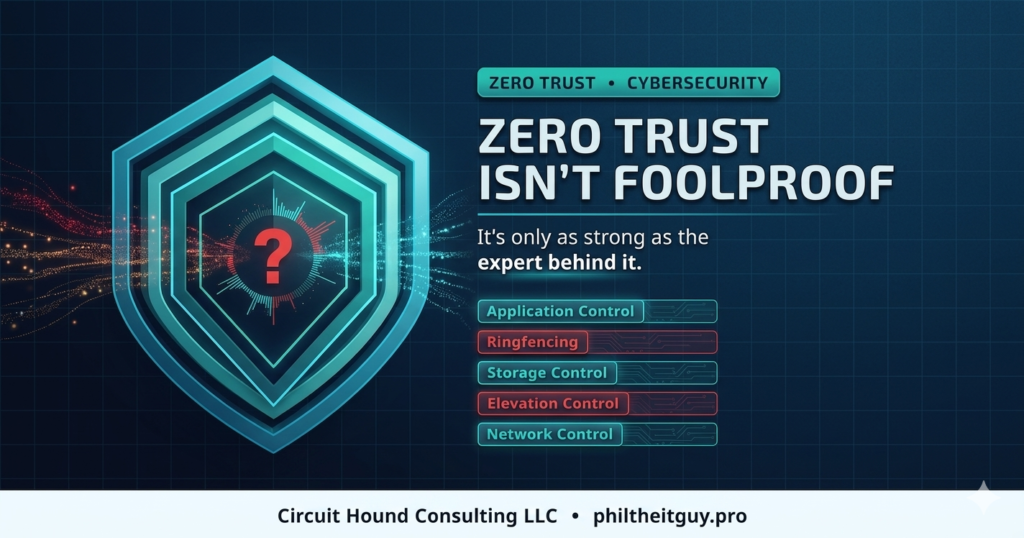
Zero Trust platforms like ThreatLocker have become the gold standard in endpoint security. The pitch is compelling — deny everything by default, allow only what’s explicitly approved. In theory, it’s bulletproof. In practice, it’s only as strong as the person configuring it.
After years of deploying and auditing ThreatLocker across hundreds of MSP and enterprise environments, I’ve seen the same gaps appear over and over. Not because the platform failed — but because the IT staff implementing it didn’t know what they didn’t know.
Application Control — The Obvious One Nobody Gets Right
Most admins get Application Control up and running and consider the job done. But approving applications by publisher, hash, or path without understanding the difference between them creates exploitable gaps. A path-based approval for C:\Program Files\ is practically an open door. Experienced engineers know to layer approvals and audit them regularly.
Ringfencing — The Feature Most Admins Have Never Touched
Ringfencing controls what an allowed application can actually do — which other processes it can interact with, whether it can access the internet, whether it can read or write to protected directories. Most deployments leave this at default. That means an approved application that gets compromised can still pivot freely. Ringfencing done right turns each application into an island.
Storage Control — Overlooked Until a Breach
Storage Control governs what can read from and write to storage devices — USB drives, network shares, cloud storage. I’ve audited environments where ThreatLocker was fully deployed but USB drives were completely unrestricted because nobody had touched the Storage Control policies. That’s a data exfiltration highway sitting wide open.
Elevation Control — The Silent Privilege Escalation Risk
Elevation Control replaces the need to give users local admin rights by allowing specific applications to run elevated on demand. When misconfigured, it becomes a privilege escalation vector. When ignored entirely, organizations fall back to giving users admin rights “just to make things work” — defeating the entire purpose of Zero Trust.
Network Control — The Feature Most MSPs Don’t Even Enable
Network Control allows granular control over which applications can communicate over the network and with what destinations. It’s one of the most powerful features in the platform and one of the least deployed. Without it, an allowed application can establish outbound connections to any destination — including command and control infrastructure.
Why Experience Across Hundreds of Customers Matters
No internal IT team or generalist MSP sees enough variety to know all the ways these configurations can go wrong. Circuit Hound Consulting brings cross-customer pattern recognition — we’ve seen what attackers exploit, we’ve cleaned up the misconfigurations others left behind, and we know exactly where the gaps hide.
If your organization runs ThreatLocker or any Zero Trust platform, a configuration audit isn’t optional. It’s the difference between having Zero Trust and just thinking you do.